Information on residual streams
SMA Mineral
SMA Mineral is one of northern Europe's leading producers of lime products. By combining efficient lime extraction with knowledge-driven processing, the company offers high-quality products for a wide range of applications such as industry, infrastructure, the environment and agriculture.
Lime residues from production (Filter dust) - Spectra A
Spectra A is lime residue collected from flue gas chambers (mainly limestone 0-2 mm), reactor and piping (limestone and small amounts of quicklime), electrostatic precipitators (limestone from the pre-dryer) and textile filters (quicklime and filter dust). The material is very fine-grained, resembles a fine powder in the dry state and has a permeability of about 4.5 × 10-⁹ m/s.
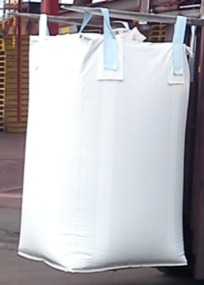
About 40 tons are produced daily and stored in a 200-ton silo, which requires emptying several times a day in big bags. The customer often requests larger quantities on a single occasion, while SMA wants more regular withdrawals. Storage in big bags is unfavourable because moisture can destroy the soil-stabilizing properties of the material.
Spectra A is mainly used for soil improvement and stabilization and as a binder in asphalt. Spectra A could be returned to the process to be burned again for the production of products. At present, there are no conditions for this. When the product is not disposed of, it is classified as non-hazardous waste.

SPECTRA A, 0-2 mm
Slaked lime - Griess
Griess is a fraction of slaked lime (calcium hydroxide, Ca(OH)₂). Slaked lime is formed when quicklime (CaO) reacts with water in an exothermic process where heat is released and the water evaporates. After slaking, the material is sieved and coarser particles (0-2 mm), Greiss, are sorted out. Greiss, has surface layers and cores that have not been completely quenched and therefore contain residual CaO.
Griess is grittier than the powdered slaked lime (Envira 0-75 μm product family), but has similar mechanical properties, with a permeability of about 10-⁹ m/s.
The material is packed in big bags of 1 500 kg, which is both time-consuming and makes marketing difficult. Other complicating factors are the size of the fraction and the fact that it is not completely extinguished. It is possible, as with Spectra A, to return Griess to the rotary kiln for re-burning and thus produce reactive agricultural lime.
Hydrated lime is alkaline and can be corrosive to skin and eyes. Handling requires protective equipment, such as gloves, eye protection and possibly respiratory protection due to the dust risk.
- Possible areas of use:
- Binder in mortar (hardens by reaction with CO₂)
- Flue gas cleaning, neutralization of acid gases
- Water treatment, to purify acidic water and separation of heavy metals
- Disinfection (milk of lime)
- Soil improvement, counteracting acidification and improving soil structure
- Pigments in paint and vegetable dyes
- Composting, outhouses and latrines
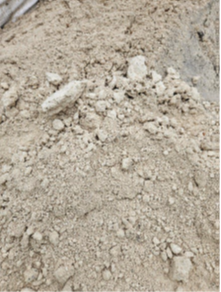
GRIESS
Start-up lime - Semi-fired limestone
Each time a rotary kiln is started up, it takes a number of hours for the temperature to become sufficiently uniform for the limestone to be 100% burnt. The limestone that passes through the kiln during these hours is called start-up lime and is semi-fired. That is, the spread of the degree of burnt lime in this material is very large. It has the fraction 0-40 mm and should be usable for something more. There is no customer at present and SMA has at least 5,000 tons in stock. As with Spectra A, it could be loaded back into the kiln and re-burned, after which it could be sold as agricultural lime. Classified as non-hazardous waste.
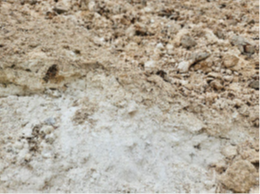
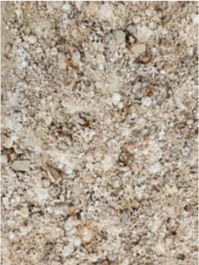
STARTING LIME, dry and white about 3 cm below the surface.
SSAB
SSAB is a leading global player in the steel industry, known for its advanced and sustainable production of high-strength steel, which plays a critical role in the development towards a more sustainable and efficient manufacturing industry.
Iron oxide
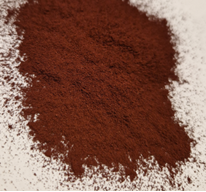
During hot rolling, iron oxide is formed on the surface of the plate and is removed in a pickling process with hydrochloric acid. The acid is recovered in an acid regeneration plant where the iron oxide is separated.
Each shipment of iron oxide is analyzed for silicon, manganese and chlorine content, which determines how the material is classified and where it is stored. The iron oxide can be delivered unground in big bags (1,000 kg) or compacted in a rod mill for higher density.
The material is sold externally and transported by truck. Depending on the results of the analysis, the iron oxide is used, for example, in the automotive industry, as a pigment in concrete, plastics and glass (e.g. matches from Swedish Match), for ferrite components (inductors, chips, magnets) and in smaller volumes for biogas plants. When the quality varies, it is more difficult to find recipients, which is why there is a desire to find more commercial alternatives for 900 grade iron oxide. Materials that currently do not suit existing customers but may be able to meet the requirements of other applications. There is also an interest in finding higher value-added applications.
Approximately 150 tons of 900 grade iron oxide are produced annually, consisting of approximately 98% Fe₂O₃ and minor amounts of silicon, manganese and chlorine. The iron oxide is classified as a by-product and is subject to product legislation.
Capstan
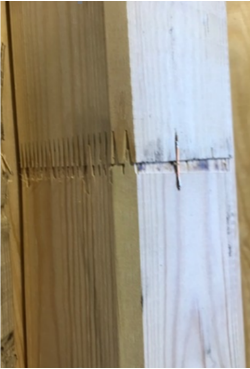
All products produced in the company's operations are packaged in some form. Cut-to-size sheet metal is packaged on lines adjacent to the cut-to-size lines for transportation to the customer. In order to facilitate lifting and handling, wooden spacers (cross and longitudinal strands) are used to create space for truck forks and cranes.
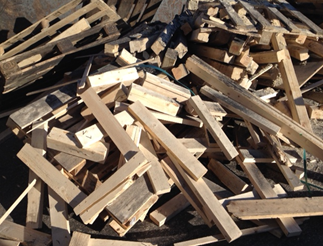
Waste wood is generated during repackaging and internal handling as well as in the packaging lines. Installed finger-jointing machines reduce the consumption of packaging wood and the amount of waste, but what is still generated is collected in containers and transported by truck to waste recipients. There is interest in finding more alternative uses for the waste wood.
Approximately 100-200 tons of waste wood are generated annually. The amount is affected by production volume, repackaging, internal logistics and finger-jointing.
Packaging wood is purchased according to specifications and must be undamaged, with no knotholes, bark, cracks or warping. The waste wood is not covered by any guarantees, but the purchase requirements provide some guidance on the quality of the waste wood.
Dimensions vary, commonly about 90 × 90 mm, 90 × 34 mm and 95 × 45 mm, sometimes with grooves (about 35 mm wide, 5 mm deep) on one side. Lengths are variable. Both spruce and pine are present.
Borlänge Energi / Falu Energi och Vatten
Borlänge Energi and Falu Energi & Vatten are municipal companies responsible for critical infrastructure such as electricity, heating, water, waste management and broadband in their respective municipalities. With local roots and sustainability in focus, they drive development towards a resource-efficient and climate-smart society.
Broken textiles
Since the law on separate textile collection was introduced in January 2025, we have a clearer picture of the flow of textiles in our municipalities. In Falun, at least 60 tons of broken textiles are collected annually - textiles that cannot be reused in their current form. In Borlänge, everything is still collected in a common flow (whole, clean and broken together) but a similar pre-sorting as in Falun is planned to start in the fall of 2025. The fraction in Borlänge should be in the same order of magnitude as in Falun. In both municipalities, contaminated textiles are sorted out separately.
The broken textiles are made of a mixture of different materials:
- Natural fibers - cotton and wool
- Synthetic fibers - polyester, nylon, acrylic, elastane
- Regenerated fibers - viscose, modal, lyocell
- Mixed materials - combinations of the above
This diversity makes recycling complex, but also offers opportunities for new uses.
Today, the majority of these textiles go to energy recovery through incineration. However, the ambition in both Falun and Borlänge is for the material to be reused or recycled to a greater extent.
Broken textiles can, for example, become a resource in new production stages - in the construction industry, furniture manufacturing, sound insulation or as composite materials. We are therefore looking for new circular solutions and industries where textiles can become a valuable raw material instead of going to energy recovery.
Hard plastic
Hard plastic is a residual stream that previously went directly to energy recovery, but since 2023 has been collected separately at the recycling centers in Falun and Borlänge. The aim is to increase recycling and reduce the amount of resources incinerated.
The fraction consists of a mixture of different plastics and the most commonly used plastics are:
- PET (polyethylene terephthalate)
- HDPE (high density polyethylene)
- PVC (polyvinyl chloride)
- PP (polypropylene)
- PS (polystyrene)
This diversity, together with colorants and additives, makes recycling complex and means that some hard plastics still need to be energy recovered. Common examples of collected hard plastics are broken toys, furniture parts, household objects and other items from both private individuals and businesses.
Since the start, Borlänge Energi has sent just over 135 tons of hard plastic for recycling, while Falu Energi och Vatten handled 62 tons in 2024 - a figure that already passed 88 tons in 2025. The hard plastic is sorted on site and then transported to various actors for further recycling.
The challenge is that recycling is currently more costly than energy recovery. To be able to utilize this resource in the long term, both technical solutions and economically sustainable models are therefore required.
Examples of hard plastic items that cannot currently be sent for recycling[ME1] :
- Frigolite
- Plastic roof
- Road cones
- Underfloor heating pipes
- Car parts
- Travel bags
- Cooling boxes
Ashes
Resulting from incineration by energy companies.
Bottom ash (sometimes called slag) is the heavier, unburned or partially burned material that collects at the bottom of the combustion chamber.
Fly ash is the finer particles that come with the flue gases and are captured in filters or purification systems, such as electrostatic precipitators or fabric filters.