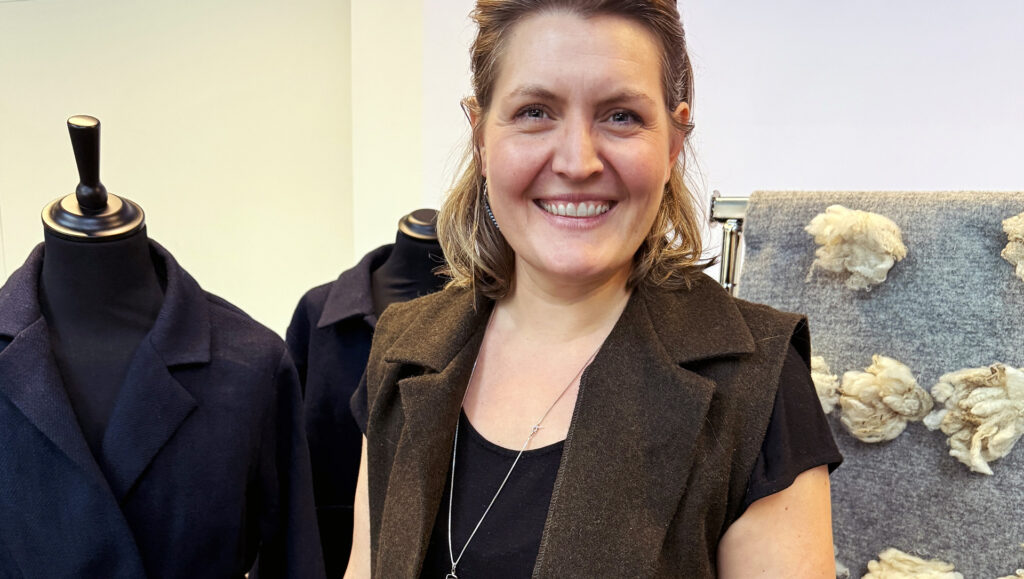
After years of being discarded as a waste product, Swedish wool is now being given a new lease of life as a sustainable, circular raw material – in everything from suits and furniture to building insulation, garden pellets, and protective gloves. Through The Swedish Wool Initiative, run by Axfoundation and Dalarna Science Park, more than 30 products and prototypes have now been developed by Swedish companies. A key success factor is the Swedish wool standard, which enables trade on an industrial scale. An efficient value chain for Swedish wool is now being built with the aim of increasing profitability. The first steps in the chain are quality assured both through the standard and the new training program for sheep owners.
Standards and training strengthen Swedish wool production
The new Swedish wool standard developed through the project makes it possible to sort wool of similar quality into the same class, which highlights the unique properties of Swedish wool and makes it easier to create larger volumes to meet industry needs. It was tested in a pilot project in 2024, when three tons of wool were collected from farms in Dalarna, classified at Rättvik Agricultural College, and processed into over 30 circular products/prototypes in construction, furniture, fashion, outdoor, and home furnishings.
Major Swedish brands such as Oscar Jacobson, Filippa K, Tiger of Sweden, Ejendals/Tegera, and Woolpower are among those that have participated in the project, says project manager Lina Sofia Lundin from Dalarna Science Park.
The wool standard is already attracting interest in Europe. Wool expert Kia Gabrielsson Beer, who classified the wool in the pilot project, believes it could become a common EU standard, thereby making trade in wool easier and fairer. Sheep farmers who want to sell wool now also have access to free training: Smart Wool Production. Together, the standard and the training help to quality-assure the first steps in the value chain and to provide the industry with a raw material of high and consistent quality.
Related links
Final report: The Swedish Wool Initiative – How we utilize Swedish wool on an industrial scale
Swedish wool standard – a national classification system for wool
Life cycle analysis of Swedish wool: Investigating products made from Swedish wool with LCA (2025)
All products/prototypes developed within the framework of the project.
Swedish wool in figures
-
- From Dalarna and northwards, there are approximately 60,000 sheep producing around 120 tons of wool per year.
-
- Approximately 1,000 tons of Swedish wool are produced each year – more than half of which has previously been discarded or incinerated.
-
- The climate footprint of Swedish wool is approximately 4–5 kg CO₂e/kg raw wool (based on economic allocation), according to the life cycle analysis conducted by The Swedish Wool Initiative. This is significantly lower than imported wool when processed in the Swedish value chain.
-
- Swedish wool is bio-based, recyclable, and biodegradable—unlike synthetic fibers that spread microplastics. Wool is naturally antibacterial, dirt-repellent, and flame-resistant—chemicals such as PFAS or biocides are not needed. Sheep grazing promotes biodiversity—it keeps land open and contributes to carbon storage.
-
- The Swedish wool industry is currently being rebuilt: In 2026–2027, Swedish Textile and Holma Helsinglands plan to build a large-scale, entirely Swedish value chain in Hälsingland. On Gotland, the entire chain exists, from collection and wool washing to spinning and weaving, via Ullkontoret.
-
- Swedish sheep contribute a range of different wool qualities – coarse wool for insulation, soft wool for clothing, and durable wool for furniture. By using Swedish wool, you are supporting animal welfare and local businesses in Sweden.
Sources: Swedish Board of Agriculture, Swedish Sheep Breeders' Association, Wargön Innovation
About The Swedish Wool Initiative
The Swedish Wool Initiative brings together actors throughout the value chain to transform Swedish wool from an untapped resource into a valuable raw material. Since its inception in 2020, the project has created opportunities for companies to access competitive Swedish wool of high and consistent quality. Over the past two years, the initiative has been scaled up to increase resource efficiency in the Swedish wool value chain and enable circular products in construction, furniture, fashion, outdoor, and home furnishings. By establishing a functioning infrastructure, developing a national Swedish Wool Standard, and creating new circular business models, the project has laid the foundation for the industrial use of Swedish wool on a larger scale. Together, partners throughout the value chain are contributing to the vision that no Swedish wool should go to waste. Read more about the project.