As AI, security, and digital autonomy move higher on the agenda, the need for new solutions is growing. Stackship, a company based in Dalarna, is developing a platform that gives organizations the benefits of the cloud without sacrificing control over their own data. The company is now taking the next step with its sights set on the European market.
“Just a couple of years ago, this was a fairly niche issue. Now, data sovereignty is on the agenda everywhere,” says Pontus Hjort, CEO and co-founder of Stackship.
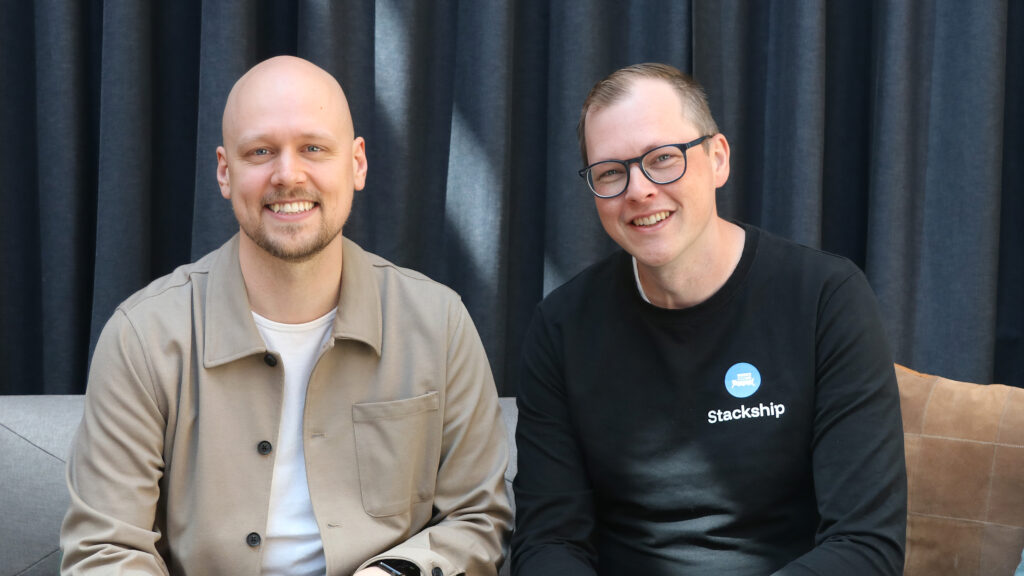
Stackship is one of the companies in the Dalarna Science Park incubator. For Pontus Hjort and Marcus Westin, the journey didn’t begin with a business idea, but with a problem they themselves encountered in their work as systems developers.
For many years, they worked on developing systems for the public sector, among others. At the same time, they saw how modern cloud platforms enabled private companies to develop and launch new services much more quickly.
“We saw two worlds. On one side were modern cloud services where new features can be rolled out in minutes. On the other side were organizations that were still operating in much the same way as they did fifteen years ago,” says Marcus Westin.
Ordering servers, configuring environments, and getting new systems up and running could take weeks or months. For organizations with high security and control requirements, there were often few alternatives.
“Many companies and government agencies can’t move everything to the cloud. But they still want the same opportunities to develop modern services. That’s where we started to see a gap,” he says.
An idea that had to wait
The idea for Stackship was conceived three years ago. At the time, it was primarily about meeting their own needs. The founders began exploring whether it was possible to create the same seamless experience that the major cloud platforms offer, but within the customer’s own environment.
At the same time, they felt that the market wasn't ready yet.
“We saw that it was possible to build it, but we weren’t sure if there was enough demand. So we put the idea on the back burner for a while,” says Marcus.
What changed everything were developments in the wider world. The war in Ukraine, increased geopolitical uncertainty, and a growing debate about Europe’s dependence on American tech giants meant that issues of data security and control quickly took on greater significance.
“Organizations began asking entirely different questions. Suddenly, it wasn’t just about technology or costs. It was about who actually controls the systems and the data,” says Pontus.
Provides customers with their own cloud
Stackship's platform is installed on the customer's own servers and makes it possible to build and run modern applications with the same ease as in the cloud. The difference is that the organization retains control over its infrastructure.
“To put it simply, we provide customers with their own cloud experience. They get the same flexibility and the same modern way of working, but the data stays with them,” says Pontus.
The solution is primarily aimed at organizations with in-house software development and high requirements for security, availability, or regulatory compliance.
This could include the public sector, defense, banking, insurance, or medical technology. It could also include companies that develop systems for these sectors.
“We’re seeing a growing need among organizations that want to modernize their development without becoming dependent on a single vendor,” says Marcus.
AI is driving development
One of the strongest driving forces behind this development is AI. More and more organizations want to explore the possibilities of generative AI, but many are hesitant to use external cloud services for sensitive information.
“We’re getting more and more questions about how to get started with AI safely. Many people see the possibilities, but at the same time want to retain control over their data,” says Pontus.
He believes that the need is particularly great in the public sector, where the requirements for transparency, security, and traceability are high.
Stackship also sees an opportunity to take the next step by enabling the development of turnkey applications using AI—in a way similar to platforms like Lovable, but where the entire solution is built and run in the customer’s own environment.
“We want to make it possible to use modern AI in the same way people use other digital tools, but with control over the entire environment,” he says.
From Dalarna to Europe
Today, the first pilot customers are on board, and more are set to join the platform.
The company has also received confirmation from both customers and major system integrators that there is a need in the market.
“We can see that the timing is right. Many organizations are actively looking for alternatives that offer greater control and increased resilience,” says Pontus.
The goal is to first establish a presence in Sweden and then continue to grow in Europe.
“Data sovereignty and digital resilience aren’t just Swedish issues. They’re European issues. That’s why we also see an international market ahead of us,” says Marcus.
To take the next step, Stackship has now launched a funding round that closes on September 30, 2026. The capital will be used to finalize the platform, strengthen the team, and prepare for the commercial launch.
But the founders' focus remains the same as it was when the idea was first conceived.
“We want to give organizations the opportunity to develop modern software and use AI without having to give up control over their own systems. That need will only grow in the coming years,” says Pontus.
Do you have an innovative business idea, or are you running a startup? Dalarna Science Park’s incubator can support you along the way. Learn more and schedule a meeting.