What happens when a ton of ice is left to melt, locked in two small houses with completely different energy standards? The Ice Box Challenge tests the building methods of the future. Dalarna Science Park has contributed sheep's wool as roof insulation in the energy-efficient house, a way to show how local resources can become part of sustainable solutions.
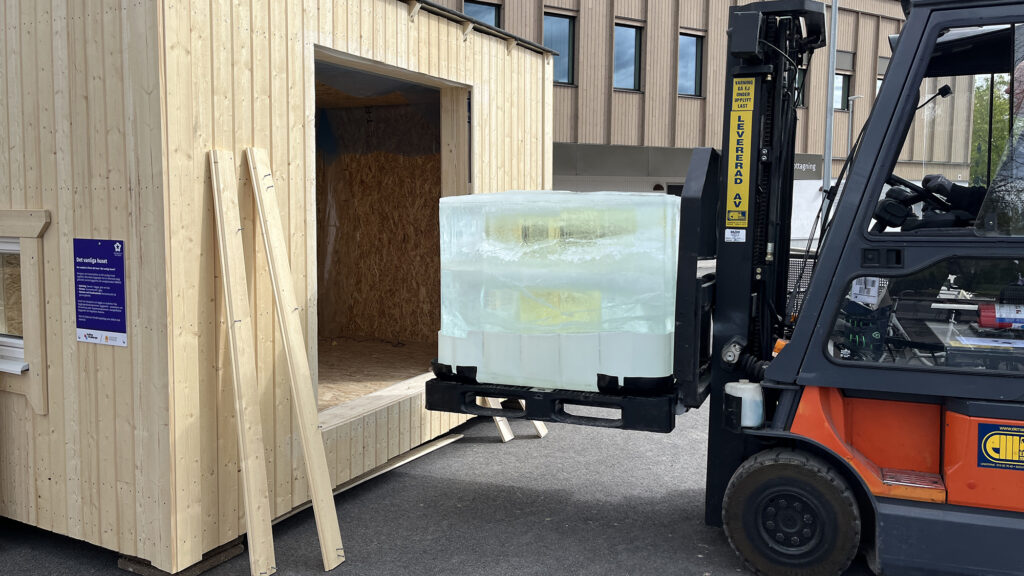
It may look simple on the outside, two small wooden houses, side by side, in the middle of central Borlänge. But inside the walls, a unique sustainability experiment is underway. One ton of ice is placed in each building, and left for a month to see how much melts. The winner? The building with the most ice left - and where the holistic approach to sustainability carries the most weight.
The Ice Box Challenge is an international competition that is being organized in Sweden for the first time this year. Students from five Swedish universities, including Dalarna University, are participating by building two house models. One according to the Swedish National Board of Housing, Building and Planning's minimum requirements and a so-called passive house, which is designed to use as little energy as possible and have minimal climate impact.
From Dalarna Science Park, we are excited to contribute to the project with sheep's wool as an insulation material in the roof of the energy-efficient building.
- Wool is an amazing resource that has long been undervalued. It has natural insulating properties, is fireproof and requires no additives. By using Swedish sheep's wool in a construction project, we hope to show how circular solutions can be put into practice," says Lina Sofia Lundin, project manager for the Swedish Wool Initiative at Dalarna Science Park.
Every year, around 1 000 tons of Swedish wool is produced. Despite this, large amounts are wasted - while wool is imported from other countries. To change this, Dalarna Science Park, together with Axfoundation and with support from Vinnova and Region Dalarna, has started the Swedish Wool Initiative. The aim is to create a better infrastructure for collecting, sorting and processing Swedish wool. In the fall of 2024, three tons of sheep wool were collected from farms in Dalarna. Some of that wool is now used in the Ice Box Challenge.
An instructive collaboration
The two buildings were designed and built by students from the Civil Engineering, Construction Technology - Production and Management and Master's programs in Energy Efficient Construction at Dalarna University. With the support of Dalarnas Försäkringsbolag and several specialized material suppliers, the project has become a concrete example of future construction.
The Passive House, in addition to the wool insulation, includes recycled facade from an old skateboard ramp, windows with built-in insulation and special beams that minimize heat leakage. The entire structure is sealed with the highest quality membrane and tape.
- This project calls itself a challenge, and it certainly lives up to its name! Bringing together the right skills, developing a design that meets the requirements for passive houses and then actually building it. At the same time, it's been a great way to put the knowledge and ideas we teach here into practice. I hope the result will convey a positive message about energy efficiency to a local, and even global, audience," says Ian Garman, a PhD student in Civil Engineering at Dalarna University.
The result, how much ice is left, will be revealed on National Day. But it's not just about winning. It's about inspiring a holistic approach to sustainability, where technology, material choices and local resources all play a role.
See the houses
The buildings can be seen in the Ovanbro parking lot, next to Dalarna University's new campus in Borlänge city center until June 6, 2025.