Perhaps you and your business are experiencing Post-Traumatic Growth? This is growth that results from coming to terms with a difficult experience. However, adversity doesn’t always lead to something good, and we know that crises don’t wait for their turn.
Climate change, conflicts, and economic instability can reinforce one another. How do we build security and the capacity to develop when we don’t know what the next challenge will be?
Imagine a program where not even the teachers have the answers. The challenge is to help a municipality dealing with flooding while its economy is shrinking. Students from different programs must work together to find a way forward. And just as the solution begins to take shape, the circumstances change.
That sounds like a pretty demanding program. However, it could turn out to be a fairly typical workweek.
The thought experiment was proposed by Isabelle McAllister and Emma Westlund during A Sustainable Tomorrow. This year’s event focused on resilience—economic, social, and ecological resilience in a time of multiple crises—and was organized by Dalarna Science Park in collaboration with Fastighets AB Hushagen, which served as the local hub in Borlänge.
Security Must Be Built Together
A key concept throughout the day was resilience. It refers to our ability to cope with change, adapt, and continue to grow as circumstances change. This applies to both people and organizations. A company or public sector organization needs to be able to handle the unexpected without losing its way.
Centralization and streamlining can reduce costs. But if all expertise or supplies are concentrated in one place, a single disruption can have major consequences. What seems efficient in everyday operations can become costly when conditions change.
The Stockholm Resilience Centre has identified nine “must-knows” that decision-makers should keep in mind when exercising their authority. In short, diverse knowledge creates more possible paths, relationships make those paths accessible, and collaborative learning helps us choose a path. Resilience is built on how resources and knowledge can flow between us, and we can build systems to facilitate this.
Practice for the Future
“We are generally educated for a reality that lies behind us,” McAllister and Westlund argued. What kind of future should we instead be preparing our young people—and ourselves—for? At their proposed “faculty of uncertainty,” students would collaborate across disciplinary boundaries and reevaluate solutions as reality changes.
The same kind of training is needed at work. Choose a key uncertainty in a project, explore it with those involved, and let the insights influence the next decision. Give the work time and assign someone to be responsible for it. That way, learning becomes part of the business.
“Inspiration isn’t enough. That’s why the participants in A Sustainable Tomorrow were asked to come up with a concrete action to start doing something differently. Does what I do provide nourishment or poison in the long run? We’re creating this transition together,” says Anna Torsgården, sustainability developer at Dalarna Science Park.
“The future we want to build needs to be just as clear as the problems we want to leave behind,” says Erik Tosterud, who works as an innovation leader at Dalarna Science Park.
The event was organized by Dalarna Science Park and Fastighets AB Hushagen and was funded with support from Region Dalarna and the EU.
A Sustainable Tomorrow
This year’s theme at the Nordic region’s largest sustainability event was economic, social, and ecological resilience in an era of multiple crises. How do we build organizations and societies that remain strong as the world changes?
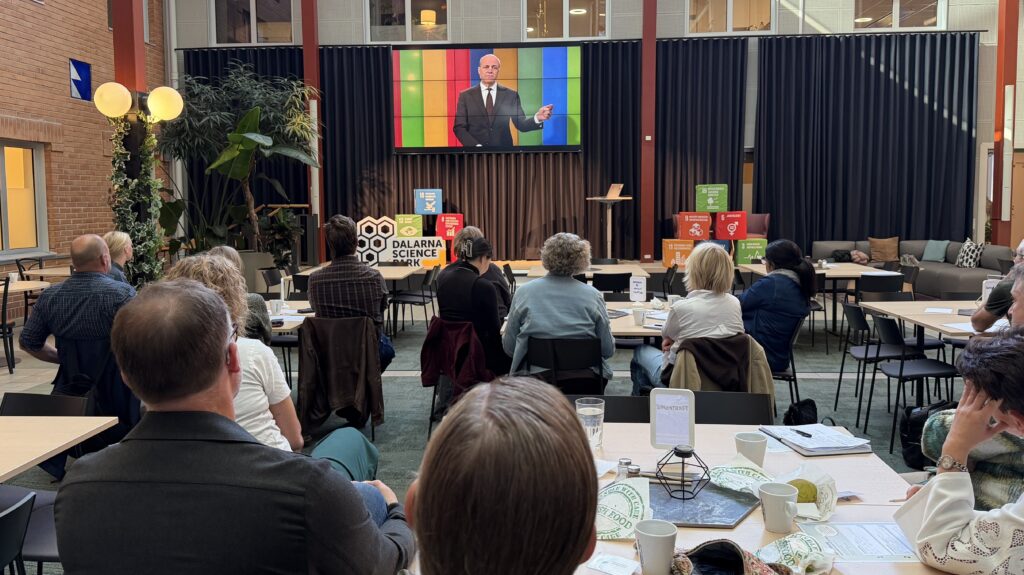
On September 10, we gathered at Dalarna Science Park, which served as the hub organizer for "A Sustainable Tomorrow."
If you have any questions, please contact me