Surplus wood from the steel industry can be given a new lease on life in preschools’ creative learning environments. It may sound unexpected, but this is precisely the kind of collaboration Dalarna Science Park aims to foster through the Circular Industry Accelerator initiative. The initiative brings together established industries with innovative companies that see opportunities where others see waste material.
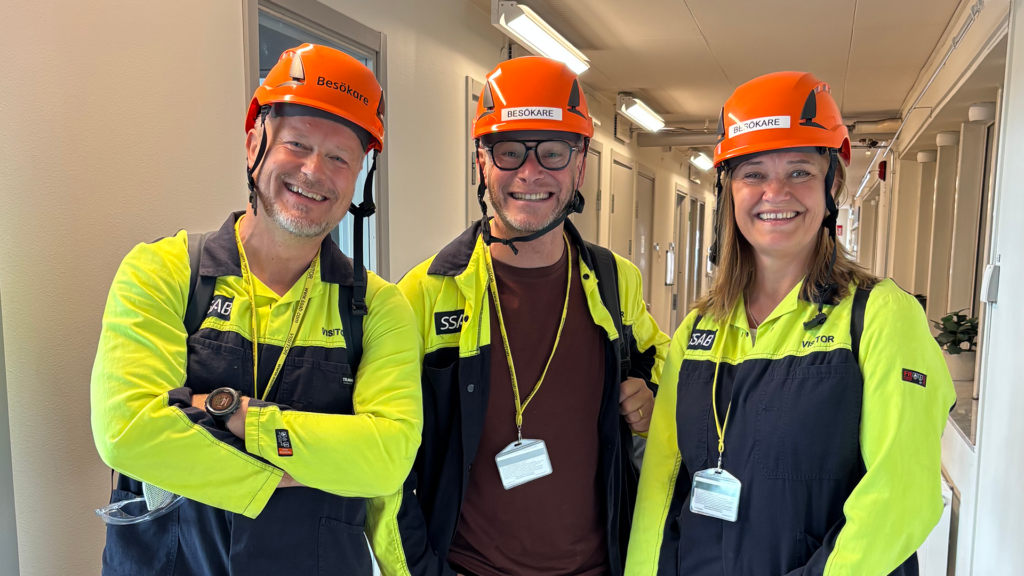
A recent example is the newly launched collaboration between SSAB in Borlänge and the Småland-based company Re:Play. They recently visited SSAB to explore how wood waste from packaging could be used as a raw material in the company’s educational products for preschools.
“For us, it’s not just about reusing materials. We want to show that resources can be given a new lease on life while also creating environments where children learn that value can be created in new ways. Circular thinking isn’t just something we talk about—it’s something the next generation will experience and explore every day,” says Stefanos Papamichailidis of Re:Play.
A waste material with new potential
When SSAB delivers steel plates, it uses wooden packaging of various lengths and dimensions to protect the material during transport. The manufacturing process generates high-quality wood scraps, which are collected in containers. Today, these wood scraps are considered waste, but they can now take on a whole new value through the company Re:Play.
“These are exactly the kinds of meetings we want to create. Small, innovative companies get the opportunity to meet with large industrial firms and, together, find new ways to make use of resources that would otherwise be at risk of being lost. That’s how new business opportunities and circular value chains can emerge,” says Carolina Friberg, project manager at Dalarna Science Park.
From Industrial Waste to Creative Play
Re:Play develops play and learning materials from leftover and waste materials from various industries. By giving these materials new uses, Re:Play helps reduce waste, improve resource utilization, and create new business opportunities. The company’s concept is also based on allowing children to explore, create, and learn with products that tell a story about resources, creativity, and the circular economy. To ensure that the materials are suitable for use in preschools, Re:Play conducts thorough quality assessments.
– We base our work on, among other things, the EU’s REACH chemical regulations and the recommendations from Giftfri Förskola, and we collaborate with external experts as needed to conduct in-depth analyses. The goal is for the materials to be both safe and sustainable.
New perspectives create the solutions of the future
The visit to Dalarna was also about building relationships for the future. Re:Play met with several companies and stakeholders in the region to explore new partnerships.
Although no final agreement has been reached yet, the meeting between SSAB and Re:Play has laid an important foundation for further development. Work will continue this fall to explore how the material flow can function both practically and from a business perspective.
Perhaps the leftover wood material from SSAB will become part of the creative learning environments of the future. But regardless of how this particular partnership develops, it demonstrates what the Circular Industry Accelerator aims to achieve: to create new collaborations where industrial byproducts become a resource for innovative companies. When different areas of expertise come together, ideas can be developed into solutions that strengthen both companies’ competitiveness and the transition to a circular economy.