Increasing population growth and exceeding planetary boundaries require new ways to solve our food production. People on our planet are starving while we produce large amounts of food waste.
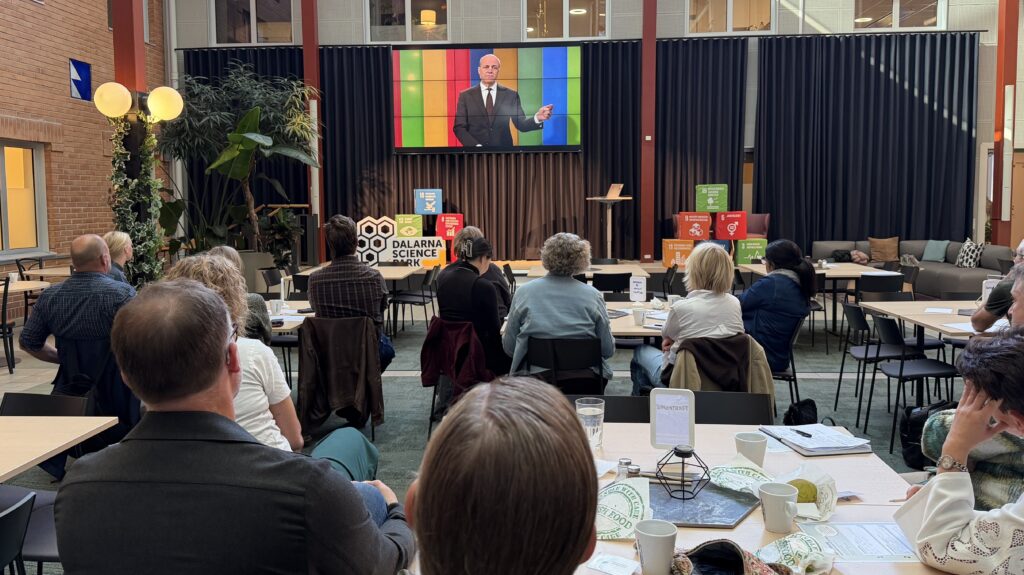
For the first time, researchers, companies and stakeholders from Sweden, Norway, Denmark and Austria gathered for two days at Dalarna Science Park to discuss how insects can be used as part of the solution to produce more sustainable food and feed.
The need for new sources of protein and increasing global unrest means that we need to become more self-sufficient and create sustainable circular food chains. Climate-smart protein production from insects could be part of the solution. Insects can become a future source of protein in the form of food for us humans but perhaps above all as feed for animals. The conference in Borlänge discussed research results, opportunities, new business and challenges in the work to develop a completely new food industry. A food industry that has the potential to become completely circular - from soil to soil.
Read more about the incubator company Tebrito that participated in the conference
- Insects need to be seen as part of our whole food system. For example, they can be part of the food chain by being fed with residues from the food industry and then in turn become feed for fish. Today, fish feed often consists of fishmeal from depleted oceans and soy produced far away. By using insects as an ingredient in feed, we can create a more locally produced and sustainable food," says David Levrén, project manager for food development at Dalarna Science Park.
Needs for the sector to develop
After the conference, we can conclude that the insect industry has potential and is predicted to develop well. The need for more sustainable and circular food production is great. In Europe alone, it is estimated that the industry could employ 25,000 people by 2030 and attract investments of €2 billion by 2025. The potential is mainly in animal feed.
But we can also see that there is still a lot of work to be done to get things moving. The focus for the industry right now is on getting volumes up and prices down to compete with cheaper alternatives. Technological development in the insect industry is progressing, but some challenges remain before large-scale production is achieved. More suppliers with the right technology are needed so that insect producers can focus on delivery and their businesses and not on developing machines. Similarly, legislation is an area where a lot has happened and is happening, but is still an issue that needs to be investigated and adapted for the industry to develop.
Many speakers highlighted the importance of cooperation between businesses, suppliers, researchers, authorities and consumers when developing a new industry.
The conference at Dalarna Science Park is part of the Interreg project KLIPP, which aims to create the conditions for large-scale production of insects for food and feed in Scandinavia.
- When the industry is not adapted or ready for new, innovative ideas, it is our task to be there and rake the ground to drive the necessary development," says Angelica Ekholm, CEO of Dalarna Science Park.
The lectures have been recorded and can be viewed afterwards.
Watch the conference afterwards!
Speakers
Speaking at the conference did:
- Anders Engström, content manager and business intelligence officer, AGFO.
- Nils Österström, CEO, Tebrito AB and Åsa Kluck, Project Manager, Tebrito AB
- Cecilia Lundin, Group Environmental Manager at Spendrups Bryggeri AB
- Gunnhild Jaastad, Dr.scient, NIBIO - Norwegian Institute of Bioeconomy Research
- Alexander Solstad Ringheim, Co-founder, Invertapro - CEO - Insect enthusiast
- Madeleine Linins Mörner, Program Manager The Future of Food, Axfoundation
- Jenny Dannstedt, Innovation Manager at Antrop, Head of Service Design
- Trygve Stølan, Senior Lecturer and Veronica Bluementhal, Senior Researcher at Østlands Research, Inland Norway University of Applied Sciences
- Simon Berner, FH-Prof. Dipl.-Ing. Dr.-Ing. from the University of Applied Sciences
- Hans Petter Olsen, CEO Denofa AS and Pronofa ASA
- Ola Albrektsson, event chef
- Nathalie Berezina, PhD, CEO of Norbite
- Lars-Henrik Lau Heckmann, Head of Business Development at Better Insect Solutions
- Ola Strom, Food Technologist, Tetra Pak